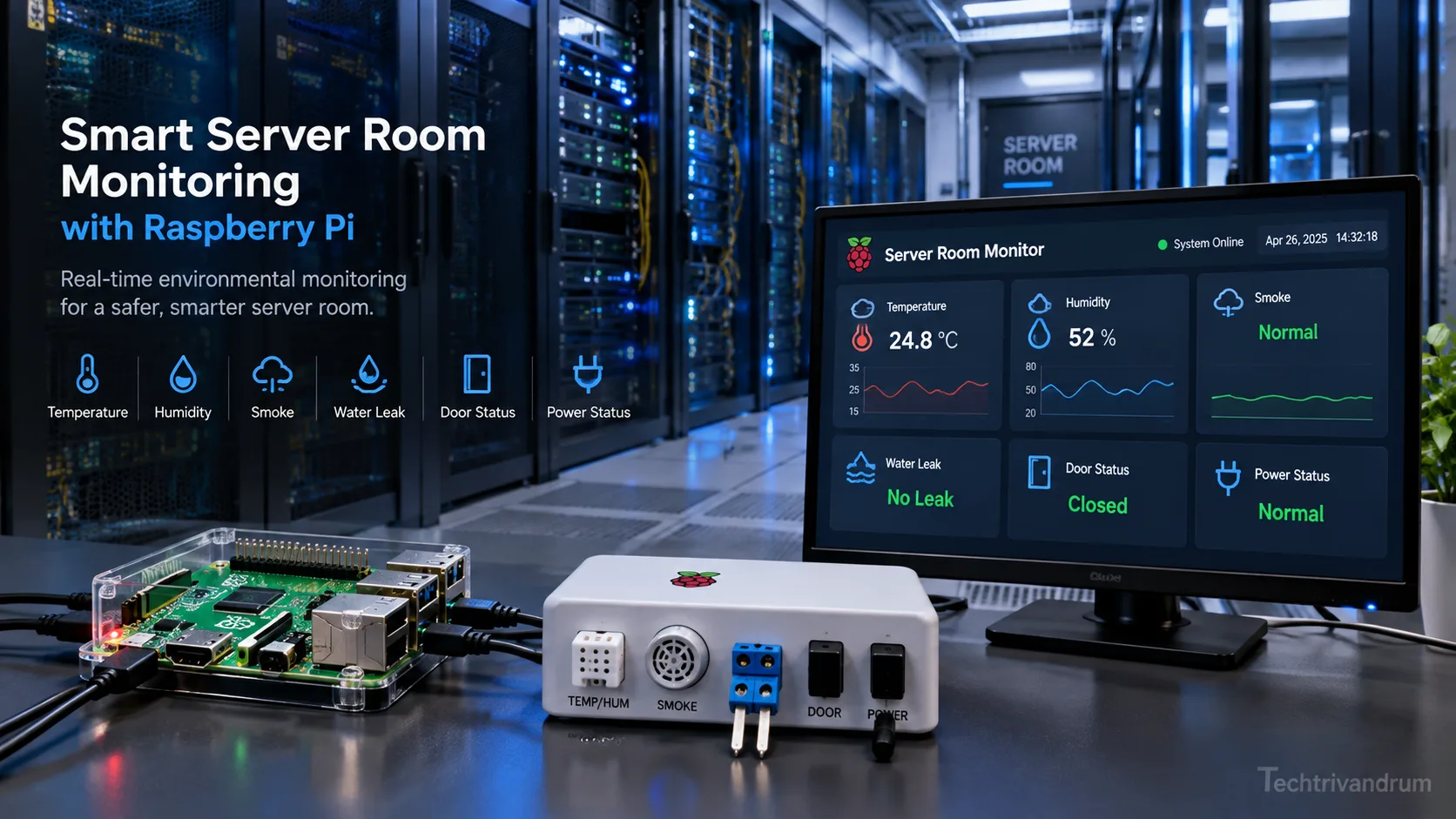
Illustrative Raspberry Pi IoT monitoring concept for server rooms, combining environmental sensors, door and power status, dashboard visualizations, historical records and configurable alerts.
IoTRaspberry Pi 4PythonFlaskSQLitePostgreSQL (optional)Chart.jsHTMLCSSJavaScriptBootstrapGPIOTelegram Bot APISMTP
A conceptual Raspberry Pi edge-monitoring solution for small server rooms, combining environmental and access sensors with a local Python monitoring service, event storage, live charts and optional multi-channel alerts.
The system and visualizations are illustrative; no physical implementation or test results are claimed.
Project Introduction
This project is a practical IoT solution designed to improve the safety and reliability of small and medium server rooms. A Raspberry Pi acts as the local edge controller and continuously collects data from environmental and security related sensors such as temperature and humidity, smoke, water leak, door contact and power status. The readings are processed locally by a Python based monitoring application, stored in a database and presented through a responsive dashboard. When a threshold is crossed or a critical event is detected, the system can immediately trigger email alerts, Telegram notifications and a local buzzer alarm.
Problem Statement
Small server rooms often lack affordable continuous monitoring. Important issues such as high temperature, humidity imbalance, water leakage, smoke, unauthorized door opening or power instability may go unnoticed until they become serious incidents. Commercial data center monitoring systems can be costly for learning environments, labs and small businesses.
Proposed Solution
The proposed solution is a low cost, customizable and scalable Raspberry Pi based monitoring platform. It brings together multiple sensors, local processing, historical data storage, real-time dashboards and multi-channel alerting into one unified system. The design allows easy extension for more sensors, remote access or cloud integration in the future.
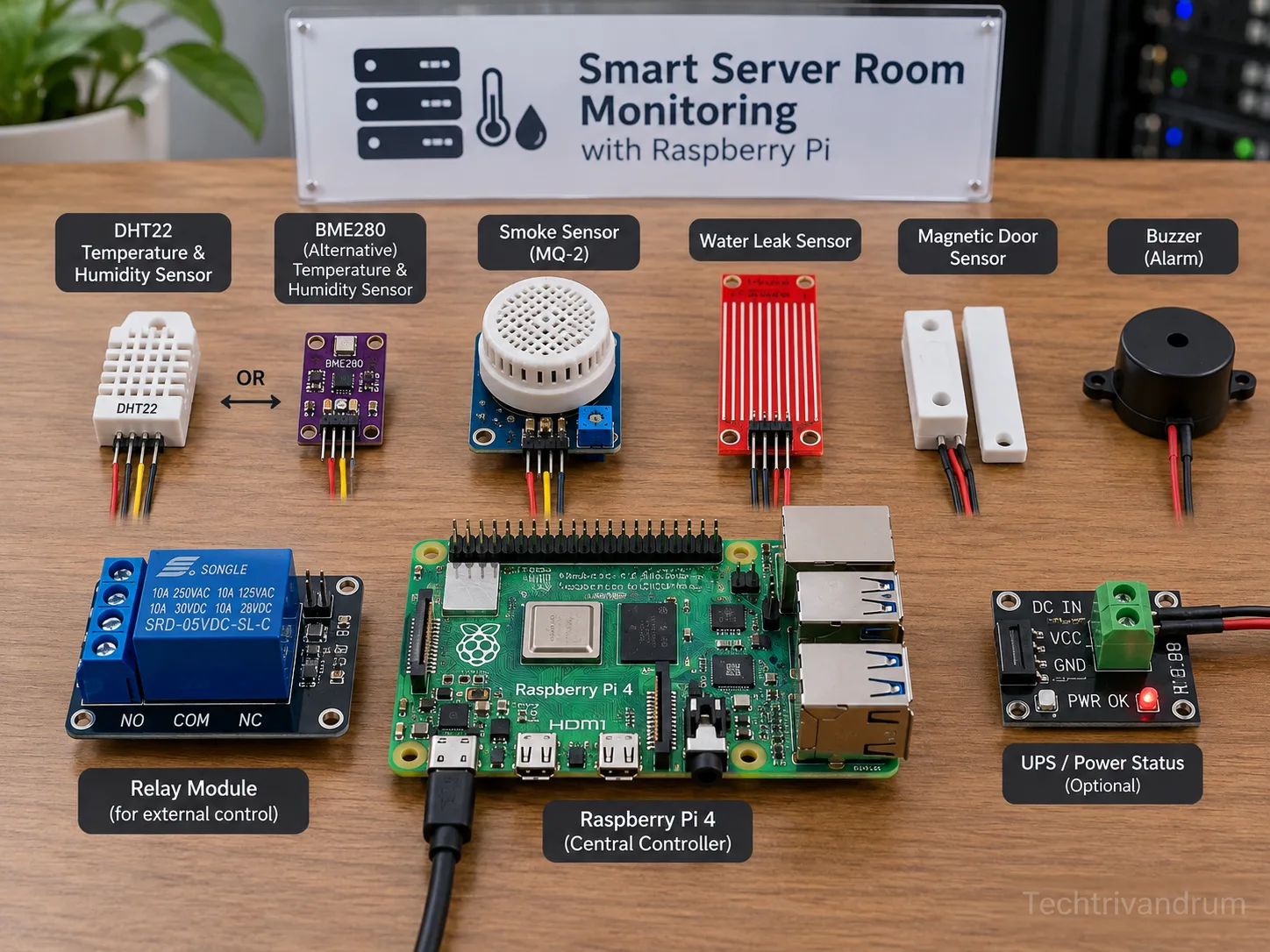
Hardware Components
Component
Purpose
Raspberry Pi 4
Central controller running the local monitoring application and dashboard.
DHT22 or BME280
Measures temperature and humidity.
MQ-2 smoke sensor
Detects smoke or abnormal air quality conditions.
Water leak sensor
Detects the presence of water near critical equipment or on the floor.
Magnetic door sensor
Monitors whether the server room door is opened or closed.
Buzzer
Provides local audible alerts inside the room.
Relay module
Optional control interface for switching alarms, lights or external devices.
Power or UPS status input
Tracks main power availability or UPS health status.
Illustrative Raspberry Pi monitoring components; component placement is conceptual.
Architecture and Data Flow
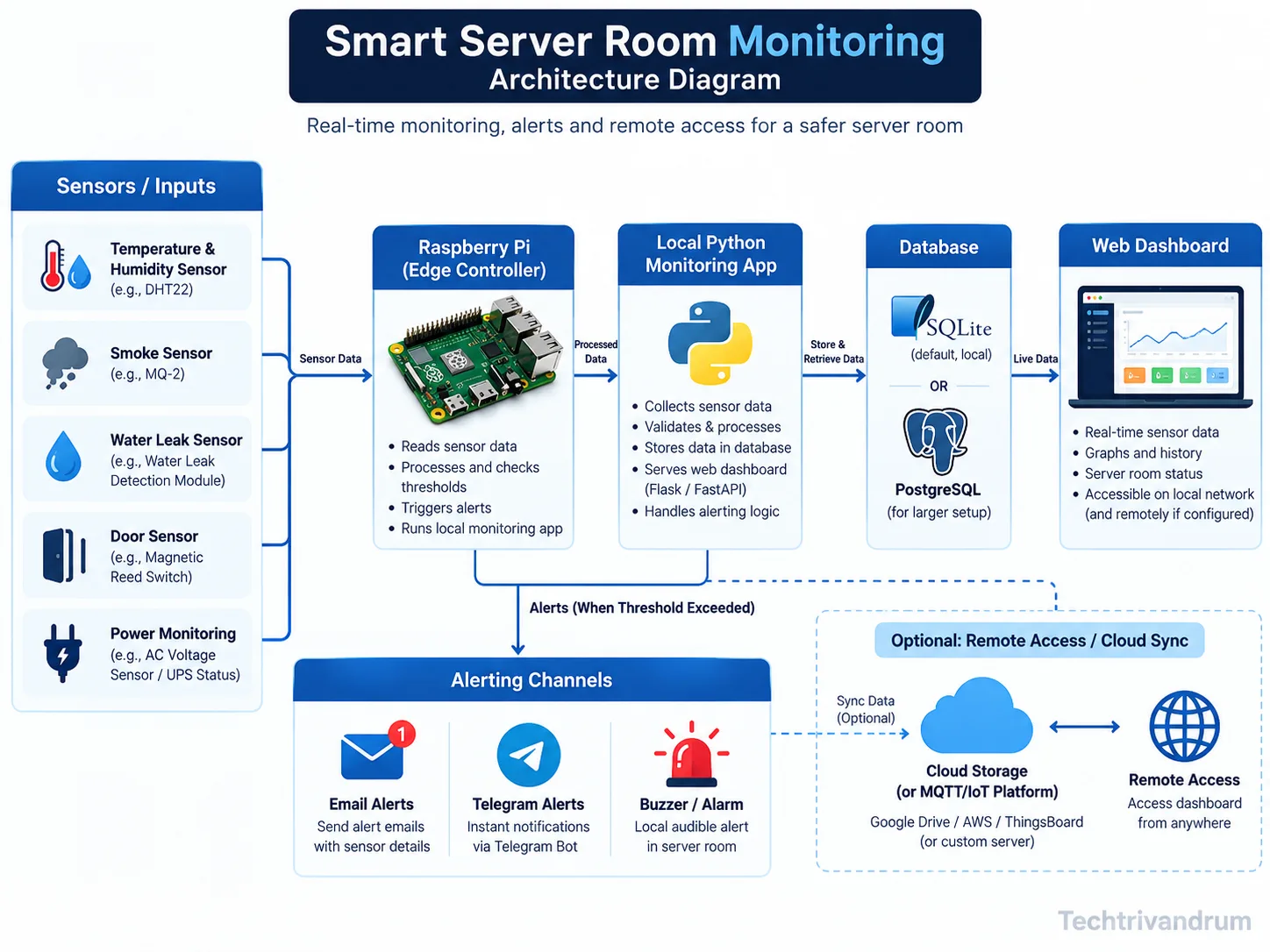
Sensor inputs are acquired by Raspberry Pi GPIO or appropriate signal interfaces. A Python service interprets samples, stores readings and events locally, and supplies data to the dashboard. An independent alert path handles buzzer activation and optional email or Telegram messaging.
Conceptual edge-monitoring architecture, with optional cloud integration.
Processing Workflow
Sensors capture environmental and security data from the server room.
Raspberry Pi reads the inputs at regular intervals.
Python application validates and processes the readings.
Data is stored locally in SQLite or PostgreSQL.
Dashboard presents live values, charts and recent events.
Alert logic triggers email, Telegram and buzzer notifications when thresholds are exceeded.
Web Dashboard
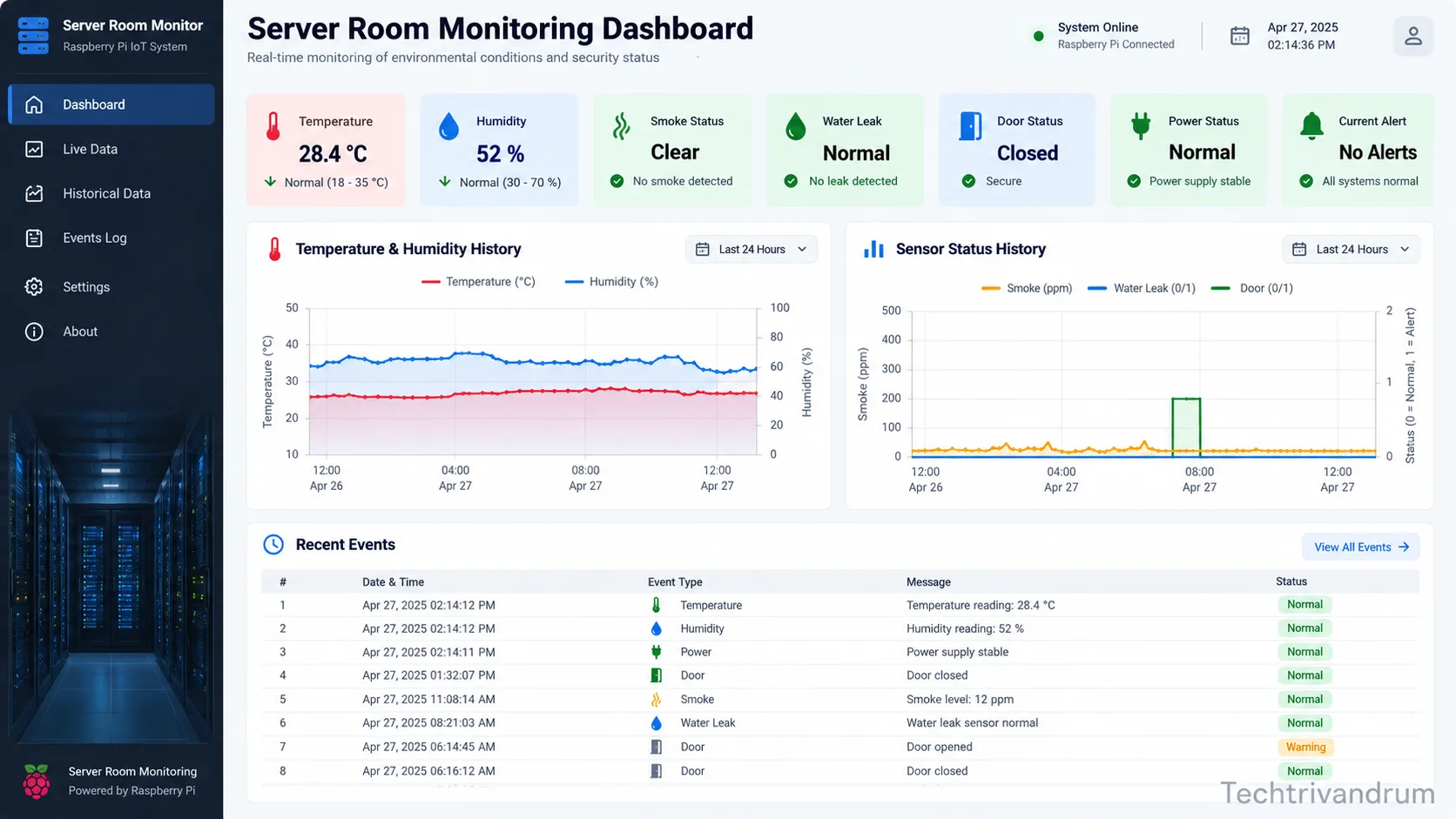
A responsive web interface is proposed to display current environmental status, charts and the recent event log. The displayed values are mock data rather than readings from a deployed system.
Illustrative desktop monitoring dashboard mockup.
Mobile Monitoring
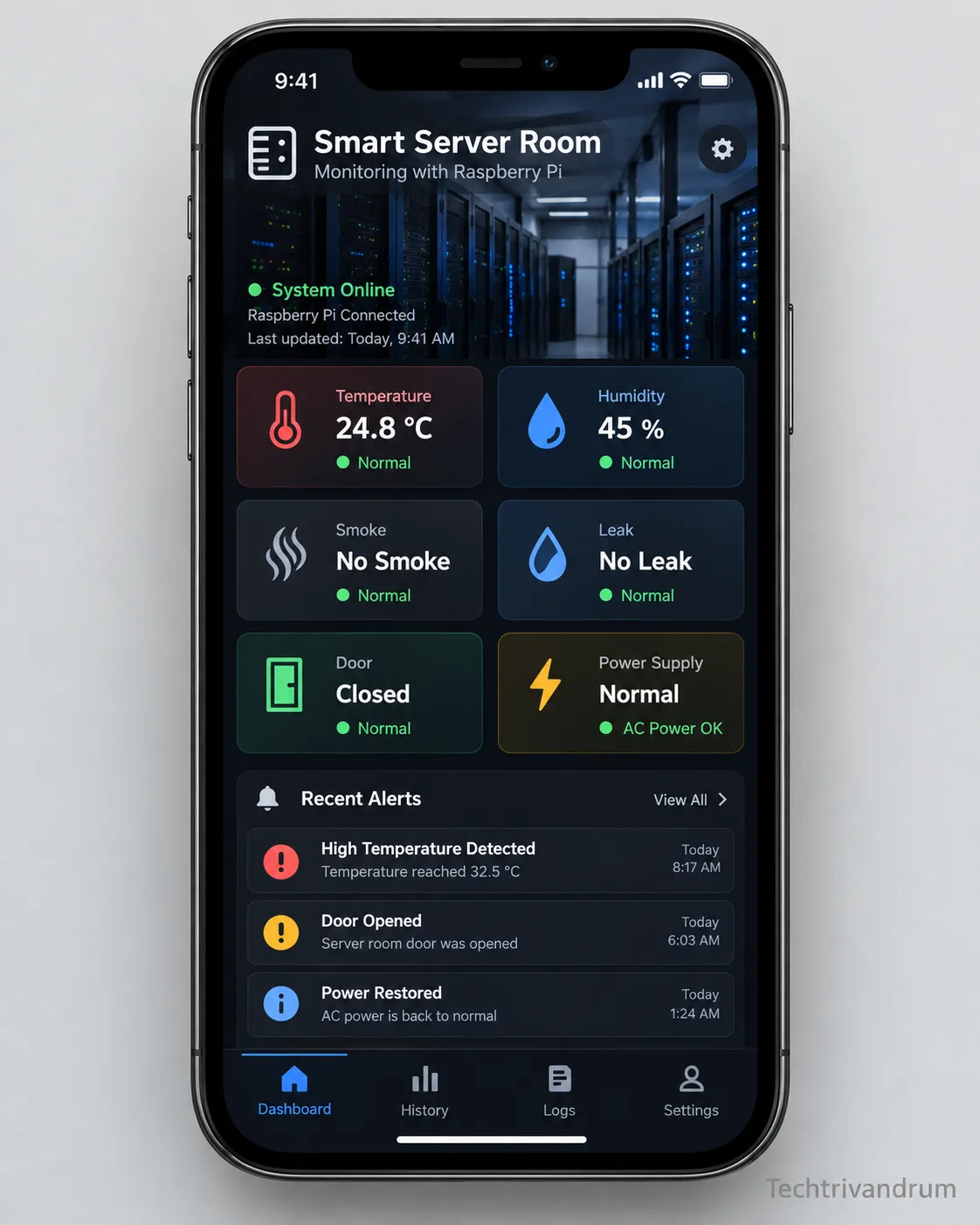
The web dashboard can be adapted to mobile screens for authorized operators.
Illustrative mobile dashboard mockup.
Alerts and Incident Notifications
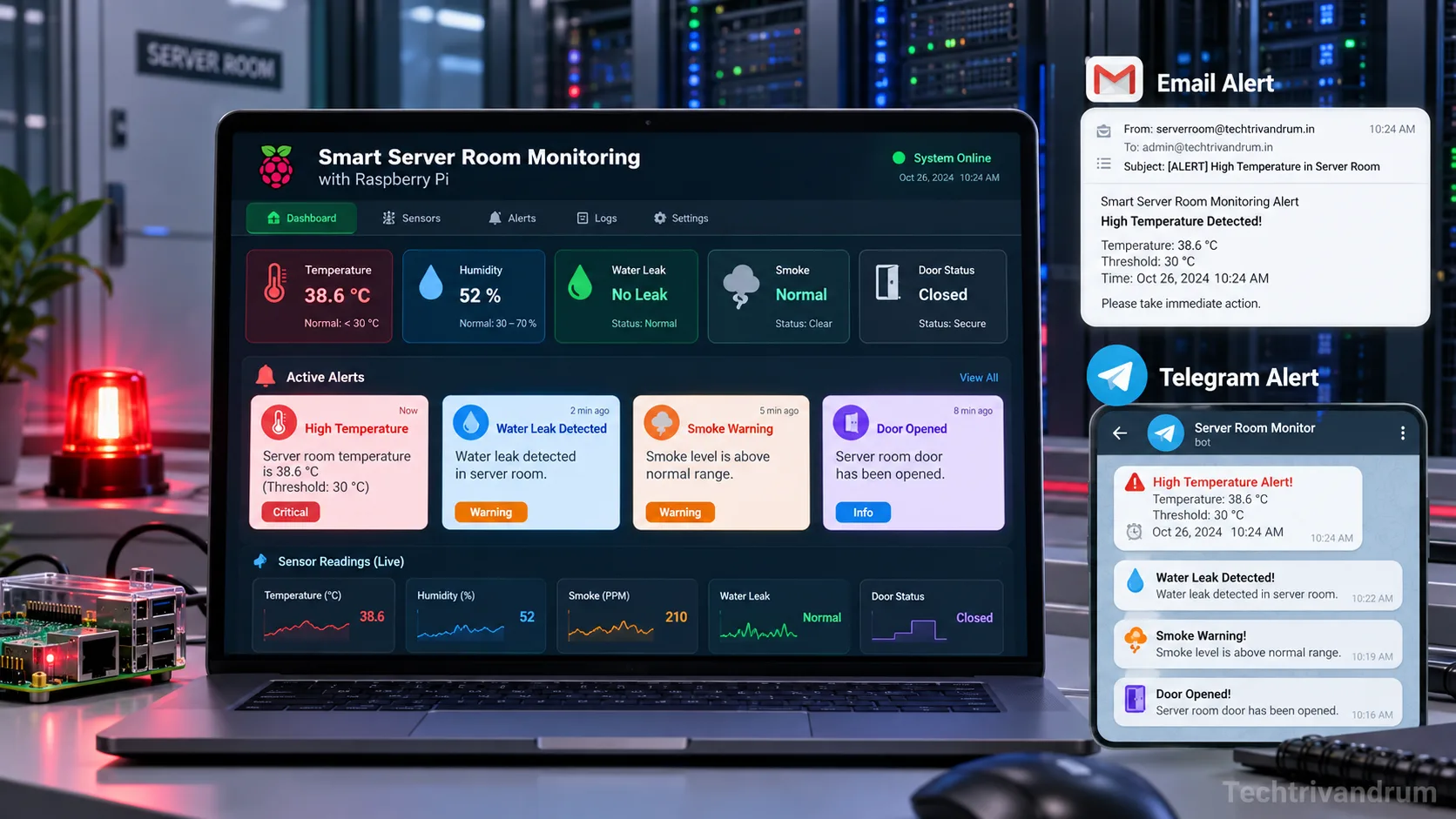
Configurable thresholds can raise local audible alerts and send optional external notifications. Rate limits, recovery messages and sensor fault checks should be implemented to reduce false alarms.
Illustrative alerting dashboard and notification concept.
Implementation Plan
Step 1: Hardware assembly
Connect the Raspberry Pi with the temperature/humidity sensor, smoke sensor, leak sensor, magnetic door sensor, buzzer and optional relay or power status module.
Step 2: Operating system setup
Install Raspberry Pi OS, enable networking and prepare Python runtime, required libraries and sensor drivers.
Step 3: Sensor integration
Write or configure Python scripts to poll sensor values and normalize them into a common format.
Step 4: Database and backend development
Create the backend service that saves sensor data, events and alert history into SQLite or PostgreSQL.
Step 5: Dashboard development
Build a responsive web dashboard to show live status, historical trends and recent events.
Step 6: Alerting and testing
Implement threshold-based alert rules, configure email or Telegram notifications, trigger simulated incidents and validate the overall workflow.
Possible Use Cases
Small company server rooms
School or college IT labs
Edge or branch office mini data rooms
Home lab environments
Network closets with critical equipment
Training and educational IoT demonstrations
Limitations and Engineering Considerations
Calibrating low-cost sensors for more reliable readings
Reducing false positives in smoke or leak detection
Protecting the Raspberry Pi and sensor wiring from noise or accidental disconnection
Designing meaningful alert thresholds for real operational use
Securing remote access if the dashboard is exposed outside the local network
Illustrative concept, not a certified protection system
This project is an unbuilt design concept with illustrative images and dashboard data. Low-cost MQ-2 sensors must not replace certified fire detection equipment. Never connect mains or UPS high-voltage terminals directly to Raspberry Pi GPIO; use suitably isolated, professionally rated interfaces.
Future Enhancements
Add camera based visual verification for incidents
Integrate with MQTT or a cloud IoT platform
Add SMS or WhatsApp based alerting through third party gateways
Introduce user authentication and role based access
Support multiple rooms or multiple Raspberry Pi edge nodes
Add predictive analytics and anomaly detection
Learning Outcomes
This project illustrates IoT monitoring architecture, Python sensor acquisition, data persistence, alerting, dashboard visualization and operational considerations for critical IT environments.
Explore a Raspberry Pi IoT concept for monitoring soil moisture, temperature, light and tank level, with proposed automatic irrigation and a plant-care dashboard.
A Python Boto3 Lambda project that snapshots production EBS volumes automatically and replicates the snapshots to another region for disaster recovery.