Skip to content
Tech Trivandrum

Smart Plant Monitoring & Automatic Watering System Using Raspberry Pi

Explore a Raspberry Pi-powered IoT plant-care concept that monitors soil moisture, temperature, humidity, ambient light and water-tank level, with automatic irrigation and a proposed monitoring dashboard.

IoTRaspberry Pi 4IoTPythonGPIOI²CSPIAutomation
01_cover_concept

Overview

A smart plant-care system can reduce routine manual checks by using connected sensors and a Raspberry Pi controller. In this proposed design, a capacitive soil-moisture probe indicates when the soil is dry, while temperature, humidity, light and reservoir-level readings provide environmental context. When predefined conditions are met, the controller may activate a small water pump for a limited interval. Measurements can also be shown on a local or cloud-connected monitoring dashboard. This project showcases an adaptable IoT design suitable for learning, prototyping and customized implementation.

Project Overview

This concept combines a Raspberry Pi, environmental sensors and a low-voltage irrigation pump to demonstrate how everyday plant care can be automated. It is suitable for students, hobbyists and organizations exploring smart gardening, home automation or precision irrigation. The design can be tailored to a single plant or extended to multiple growing zones.

How the System Works

  1. A capacitive soil-moisture sensor produces an analog voltage related to soil conditions. An MCP3008 analog-to-digital converter allows the Raspberry Pi to read this signal.
  2. A DHT22 measures air temperature and relative humidity; a BH1750 measures ambient illumination.
  3. An HC-SR04 sensor mounted above the water surface estimates reservoir level from measured distance.
  4. The Raspberry Pi periodically evaluates sensor data against configured limits.
  5. If the soil is dry and the reservoir level is safe, a relay-controlled pump can deliver water for a short, controlled interval. The system waits before repeating to avoid overwatering.
  6. Measurements and pump events can be presented on a dashboard; optional notifications can warn of an empty tank or sensor failure.

Suggested Hardware

ComponentQuantityPurpose
Raspberry Pi 4 and suitable power supply1Main controller
Capacitive soil-moisture probe, 3.3 V compatible1Soil moisture sensing
MCP3008 ADC1Reads analog soil sensor
DHT221Temperature and humidity
BH1750 light sensor1Light-level monitoring
HC-SR04 distance sensor1Reservoir-level estimate
3.3 V GPIO-compatible relay driver1Pump switch
5 V DC mini pump + separate rated supply1Water delivery
Tubing, tank, resistors, wiring and enclosureAs neededSafe assembly

Proposed Hardware Connections

The DHT22 data line connects to GPIO4; BH1750 uses I²C (GPIO2 SDA and GPIO3 SCL); MCP3008 uses SPI (GPIO8 CE0, GPIO9 MISO, GPIO10 MOSI, GPIO11 SCLK), with the soil sensor output feeding MCP3008 CH0. The ultrasonic sensor uses GPIO23 for TRIG and GPIO24 for ECHO **through a suitable 5 V to 3.3 V divider or logic-level converter**. A compatible relay driver is controlled from GPIO17 and switches a separately powered DC pump.

Raspberry Pi GPIO pins

Raspberry Pi GPIO pins are 3.3 V only. Never connect a 5 V ECHO output directly to a GPIO input or power the pump from a GPIO pin. Keep electronics isolated from water, use a properly rated power supply, and independently verify each module's pinout and logic levels before wiring.

Monitoring Dashboard Concept

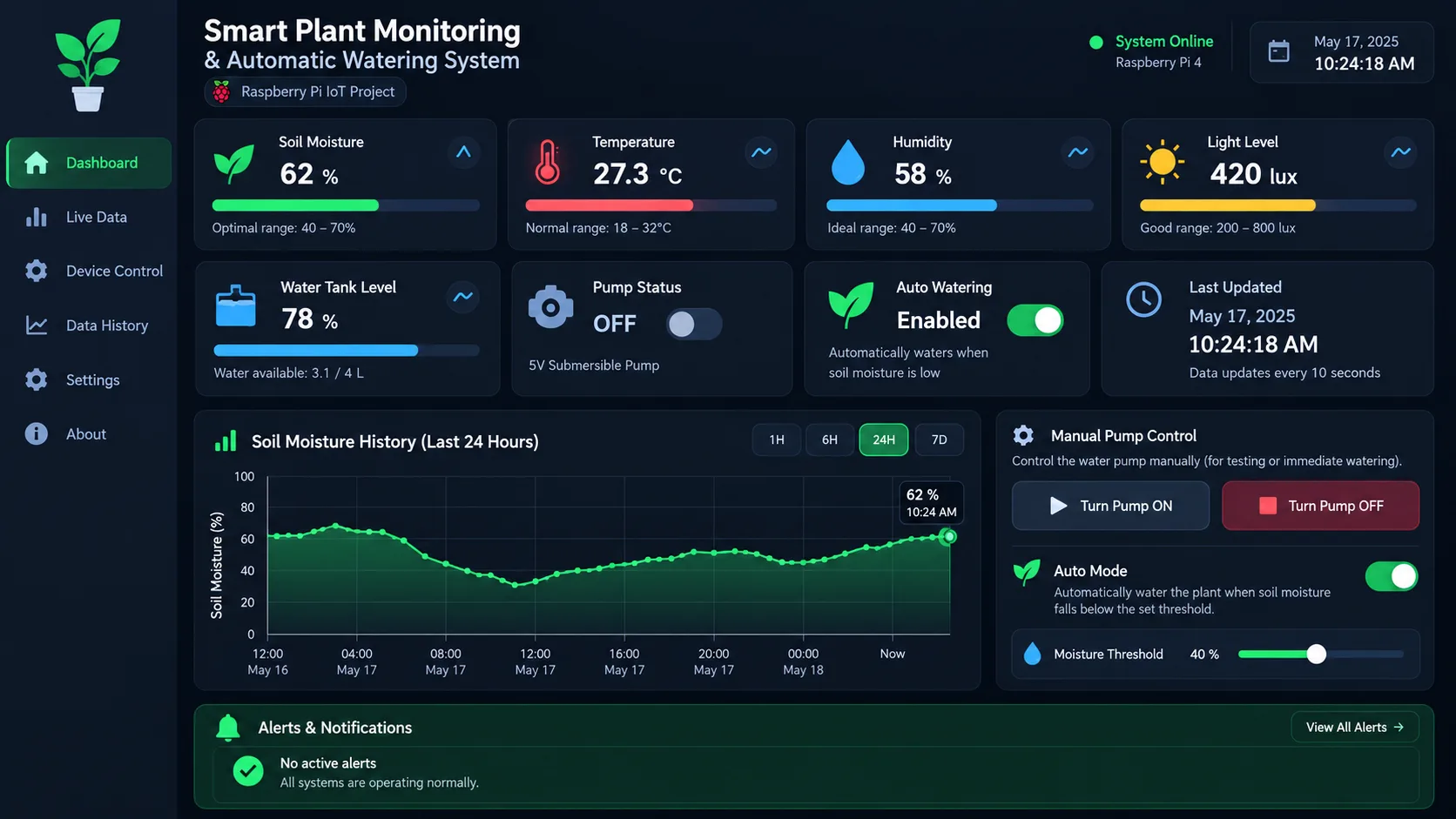
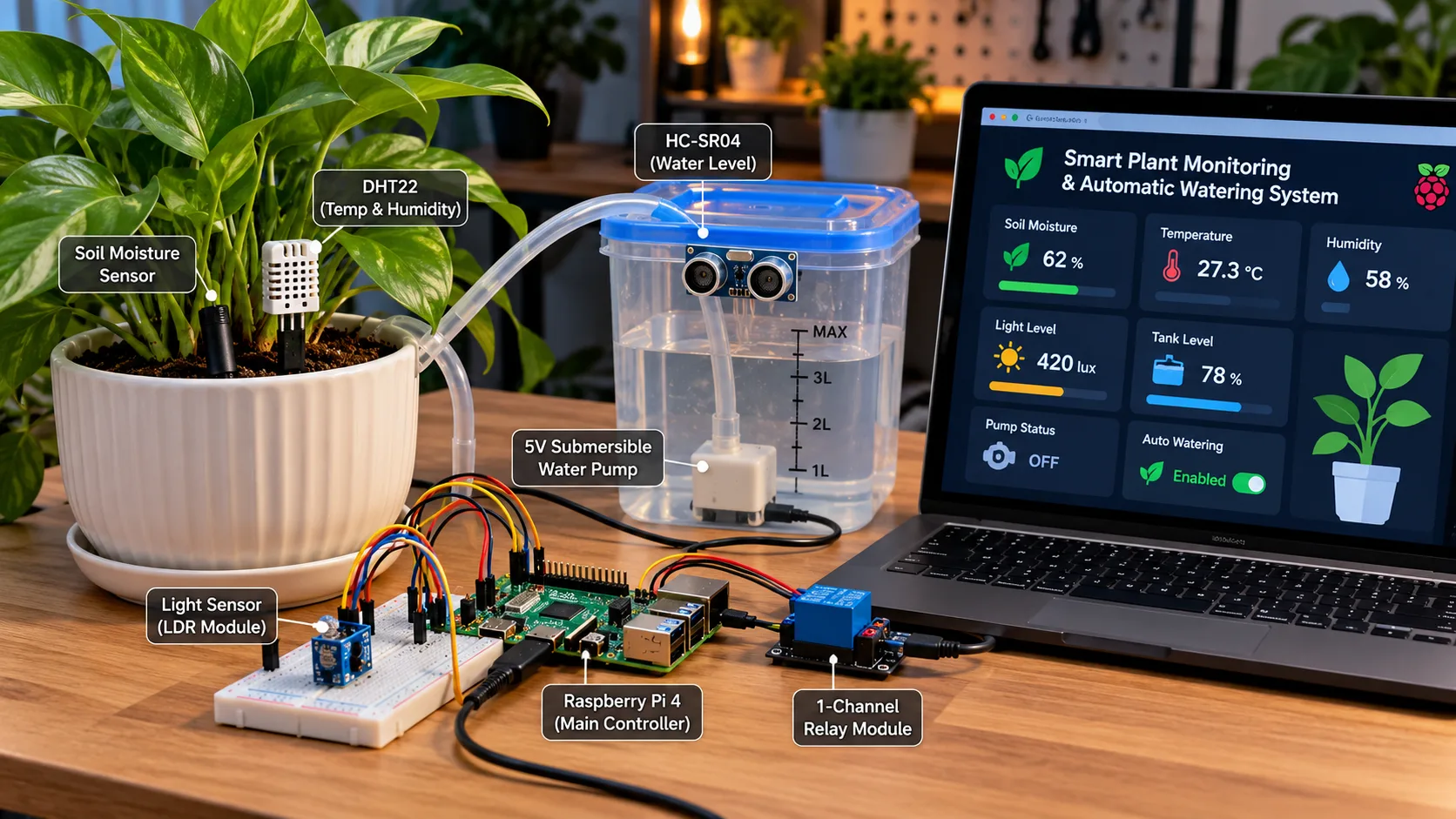
A proposed dashboard can display soil moisture, temperature, humidity, light intensity, reservoir level, pump state and recent trends. It can also offer adjustable watering thresholds and notifications. The dashboard illustration included here uses **example values**, not real-time readings from a deployed device.

Applications and Extensions

Potential uses include home gardening, educational demonstrations, greenhouse experiments, and small-scale irrigation prototypes. Further development could add multiple soil zones, weather-aware watering, cloud telemetry, mobile notifications, battery or solar power, and historical analytics.

Interested in Building This Project?

TechTrivandrum can help you explore a customized implementation, including component selection, hardware assembly, Raspberry Pi programming, circuit design, dashboard integration and deployment planning. Contact us through the website to discuss your requirements.

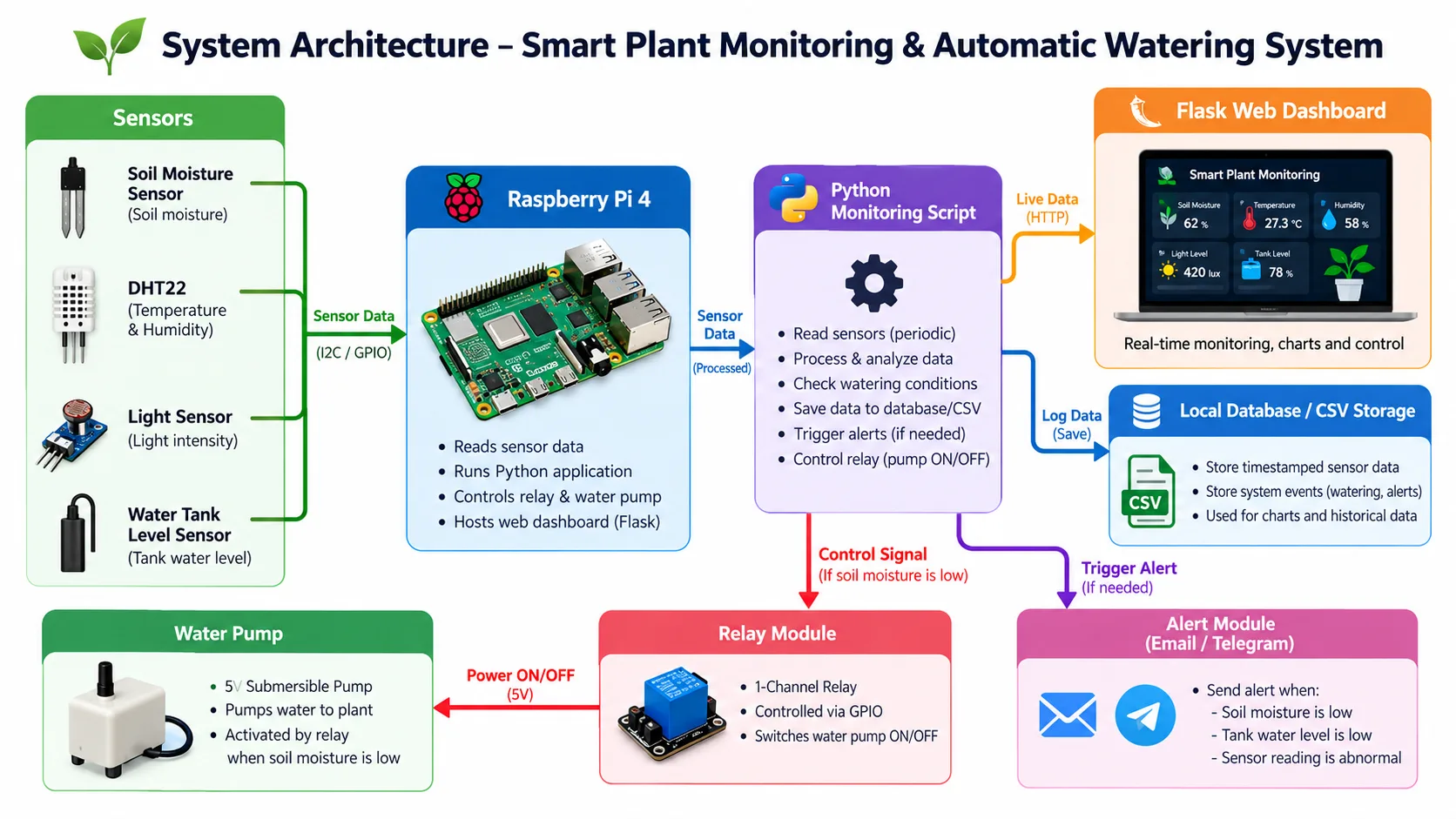
03_architecture_illustration
Illustrative high-level architecture and optional modules

Architecture

03_architecture_illustration

Screenshots

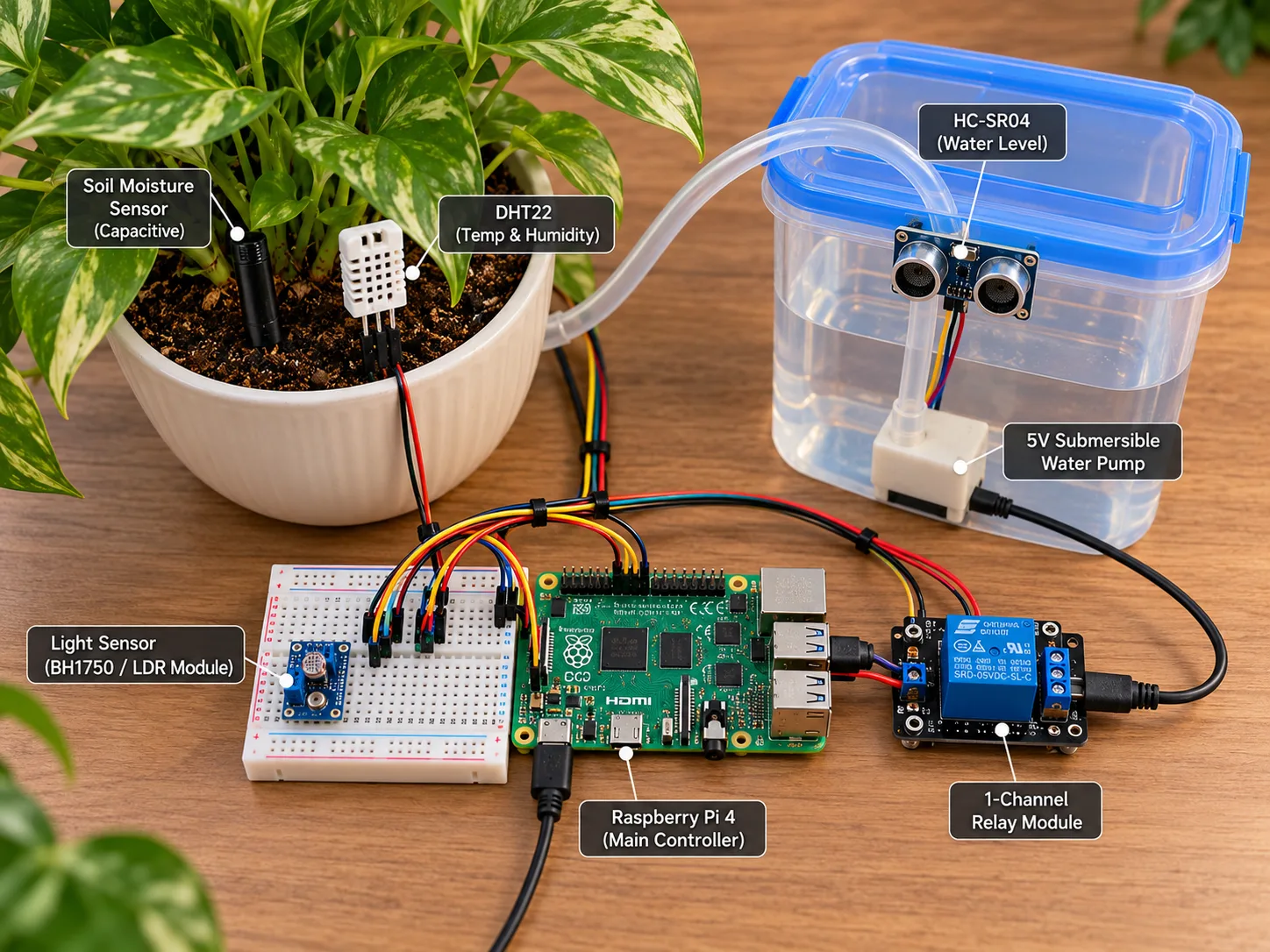
Illustrative hardware arrangement showing the Raspberry Pi, plant sensors, relay module, water reservoir and irrigation pump.
Illustrative arrangement of the proposed plant-monitoring hardware
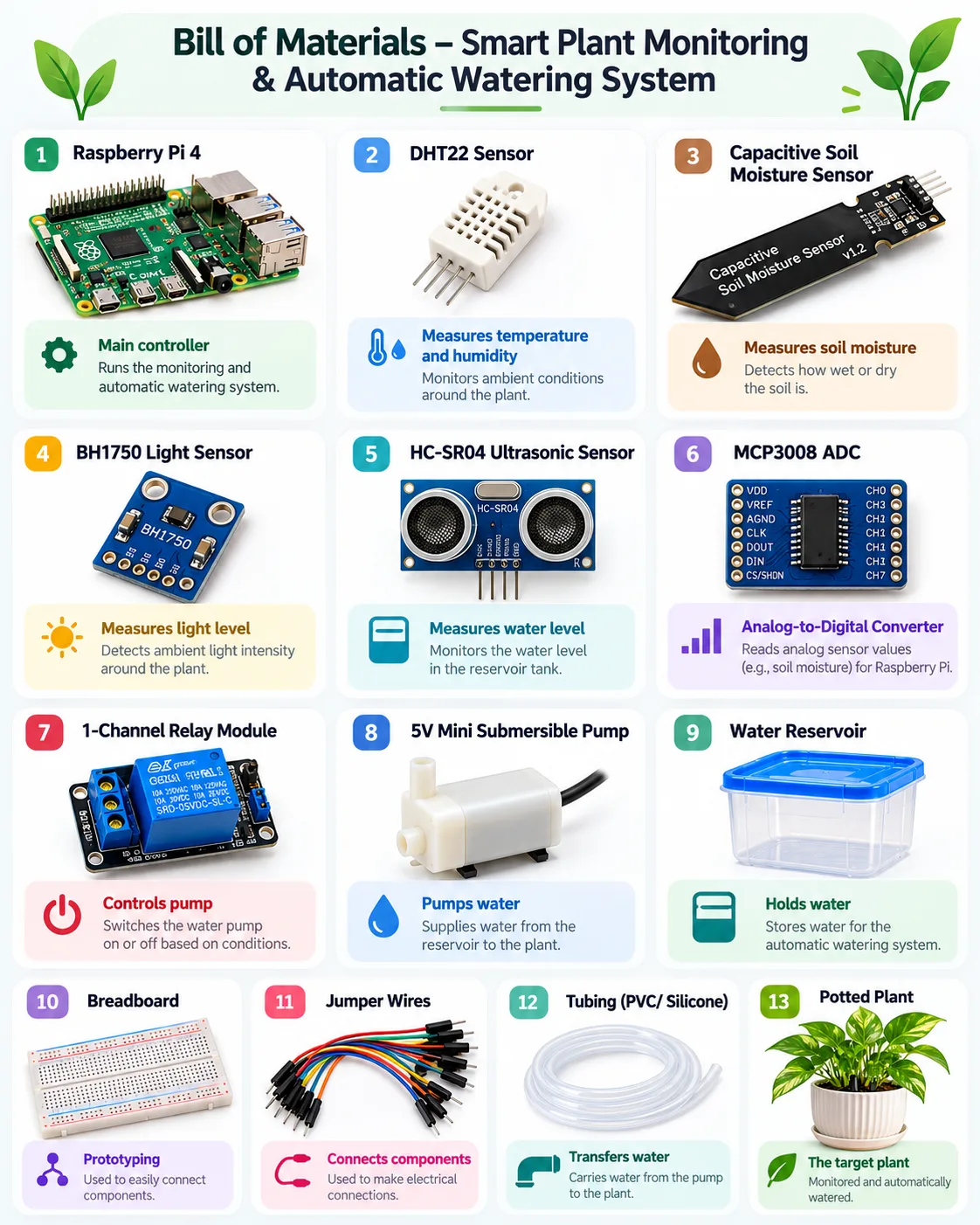
Proposed main hardware components (illustrative)
Suggested hardware components for the proposed smart plant monitoring and automatic watering system.
Dashboard UI concept using example, not live, readings

More projects